
"Denoising for high-magnification bioluminescence imaging of cells by machine learning with physics-based noise modeling of EMCCD" by Tetsuichi Wazawa, Haiyang Jiang, Ryohei Ozaki-Noma, Yinqiang Zheng, Imari Sato, Takeharu Nagai is published in BPPB as the J-STAGE Advance Publication.
2026 July 25 BPPB
A following article is published as the J-STAGE Advance Publication in "Biophysics and Physicobiology".
Tetsuichi Wazawa, Haiyang Jiang, Ryohei Ozaki-Noma, Yinqiang Zheng, Imari Sato, Takeharu Nagai
"Denoising for high-magnification bioluminescence imaging of cells by machine learning with physics-based noise modeling of EMCCD"
URL:https://doi.org/10.2142/biophysico.bppb-v23.0025
- Abstract
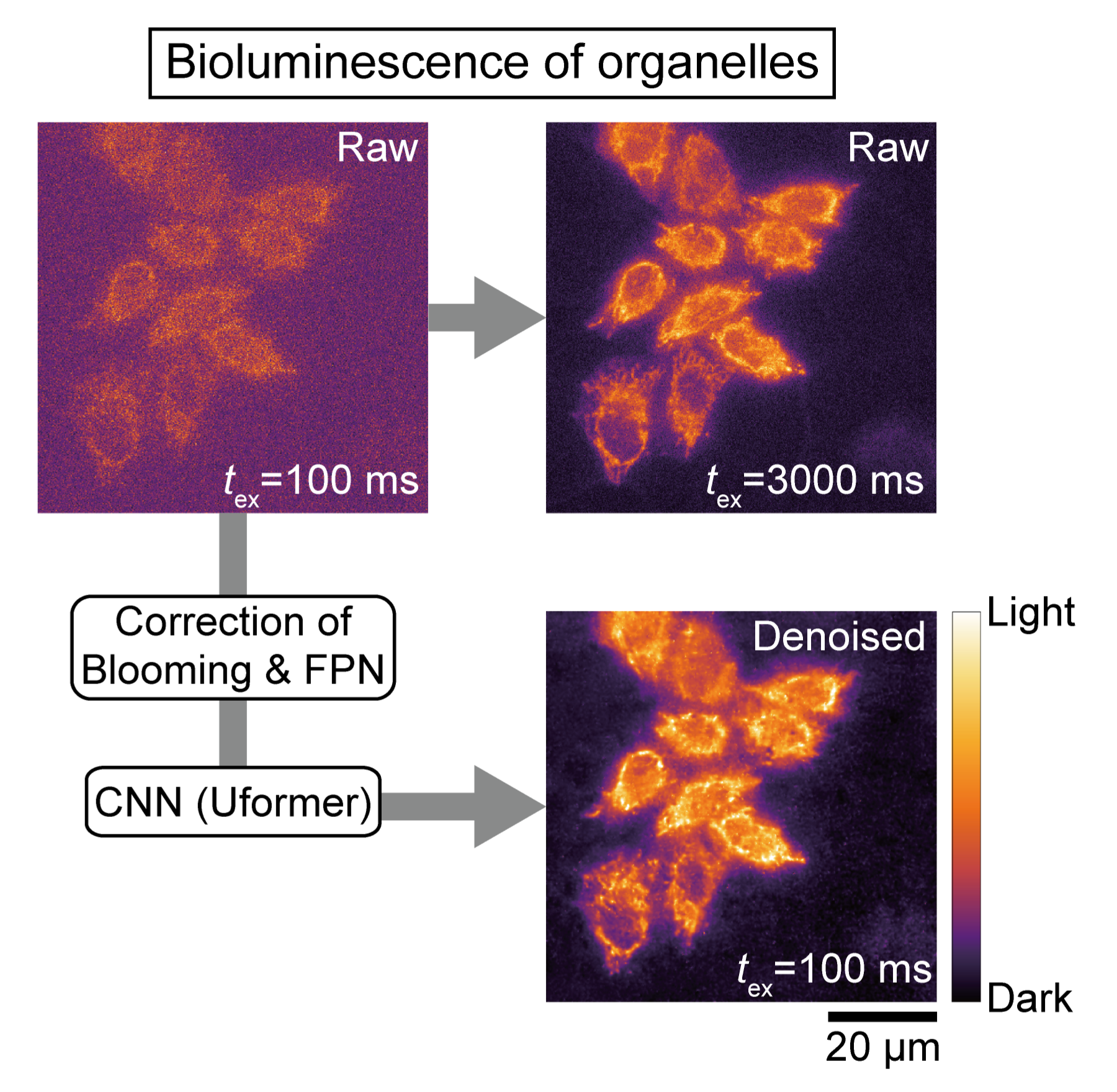
- Bioluminescence imaging (BLI) detects light emission from samples expressing luciferase in the presence of luciferin. Unlike fluorescence imaging, BLI does not require excitation light, thereby avoiding phototoxicity in living cells and photobleaching of labels. However, the intrinsically slow turnover of the luciferin-luciferase reaction often results in low luminescence intensity, which degrades image quality and limits practical applications, particularly in high-magnification optical microscopy of cells. In this study, we demonstrate that image denoising provides an effective strategy to overcome this fundamental limitation of BLI. We developed a physics-based noise model that incorporates fixed-pattern noise, blooming noise, readout noise, quantization noise, and Poisson shot noise, enabling accurate estimation of noise parameters encountered in EMCCD-based microscopy. In the denoising pipeline, raw noisy images were first corrected for the fixed-pattern and blooming noises, followed by restoration using Uformer neural network trained with paired ground-truth images and synthetically generated noisy images. Quantitative evaluation using the peak signal-to-noise ratio (PSNR) and structural similarity index measure (SSIM) showed that denoised images derived from raw data acquired with exposure times of ≤100 ms achieved PSNR and SSIM values comparable to those of raw images acquired with exposure times of 1–3 s. These results indicate that the proposed denoising approach substantially extends the practical limit of high-magnification BLI.