
"Massively parallel estimation of dissociation constant for ligand proteins using molecular display technologies and next-generation sequencing" by Takuyo Aita, Yukino Ito, Kakeru Suzuki, Masatoshi Yamaguchi, Naoto Nemoto, Shigefumi Kumachi is published in BPPB as the J-STAGE Advance Publication.
2026 September 26 BPPB
A following article is published as the J-STAGE Advance Publication in "Biophysics and Physicobiology".
Takuyo Aita, Yukino Ito, Kakeru Suzuki, Masatoshi Yamaguchi, Naoto Nemoto, Shigefumi Kumachi
"Massively parallel estimation of dissociation constant for ligand proteins using molecular display technologies and next-generation sequencing"
URL:https://doi.org/10.2142/biophysico.bppb-v23.0031
- Abstract
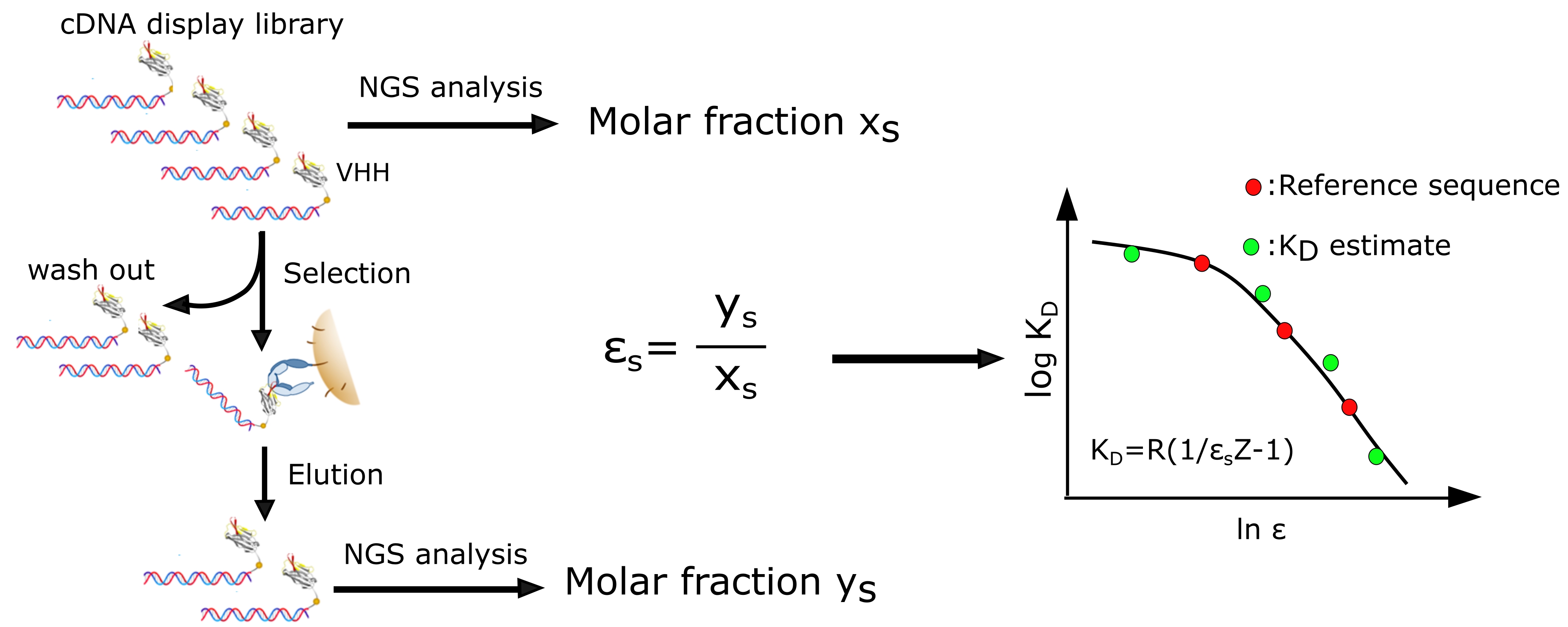
- For a vast library of ligand proteins, it is difficult to directly measure the dissociation constants KD of each ligand with its target receptor. We propose a massively parallel method to estimate KD values using “cDNA-display molecules”, in which the ligand protein is tagged with a cDNA molecule that represents its genotype. Our approach is based on fundamental equations governing chemical equilibrium and in vitro selection dynamics, and is quite straightforward. First, through a single selection process and subsequent next-generation sequencing (NGS), the “enrichment ratio” εs ≡ ys/xs for each sequence is calculated, where xs and ys are respectively the molar fraction of sequence s for immediately before selection and that for after selection. Next, KD values for several “reference sequences” chosen from the library are measured, and a calibration curve representing the relationship between ε and KD is obtained. Then, we can estimate KD values for other sequences based on their ε values. We applied the method to two different VHH libraries: one consists of local sequence space (Case 1) and the other consists of global sequence space (Case 2). To evaluate the validity of the method, the KD estimates for 6 - 28 reference sequences were compared with their measured values. As a result, the correlation coefficients between them were 0.98 for Case 1 and 0.79 for Case 2, suggesting that our method is highly effective. Theoretically, large-scale NGS increases the prediction accuracy, and then the method is expected to become more practical.