

男女共同参画学協会連絡会
支援企業による広告記事
- ソーラボジャパン株式会社
- CAD を使って光学装置を設計してみよう
- 「生物物理」2025年10月号
- ソーラボジャパン株式会社
- 次世代2光子顕微鏡―小型化がもたらす新たな可能性
- 「生物物理」2024年10月号
- ソーラボジャパン株式会社
- サイエンティフィックカメラと周辺機器の同期
- 「生物物理」2023年10月号
- ソーラボジャパン株式会社
- 顕微鏡のリノベーション ~ 顕微鏡ポートを活用した光学系の導入
- 「生物物理」2022年12月号
「Biophysics and Physicobiology」に Hisashi Okumura, Linh Truong Hoai, Pornthep Sompornpisut, Satoru G. Itoh による "A lattice Monte Carlo model for amyloid fibril formation" をJ-STAGEの早期公開版として掲載
2026年05月09日 学会誌
日本生物物理学会欧文誌[Biophysics and Physicobiology]に以下の論文が早期公開されました。
Hisashi Okumura, Linh Truong Hoai, Pornthep Sompornpisut, Satoru G. Itoh
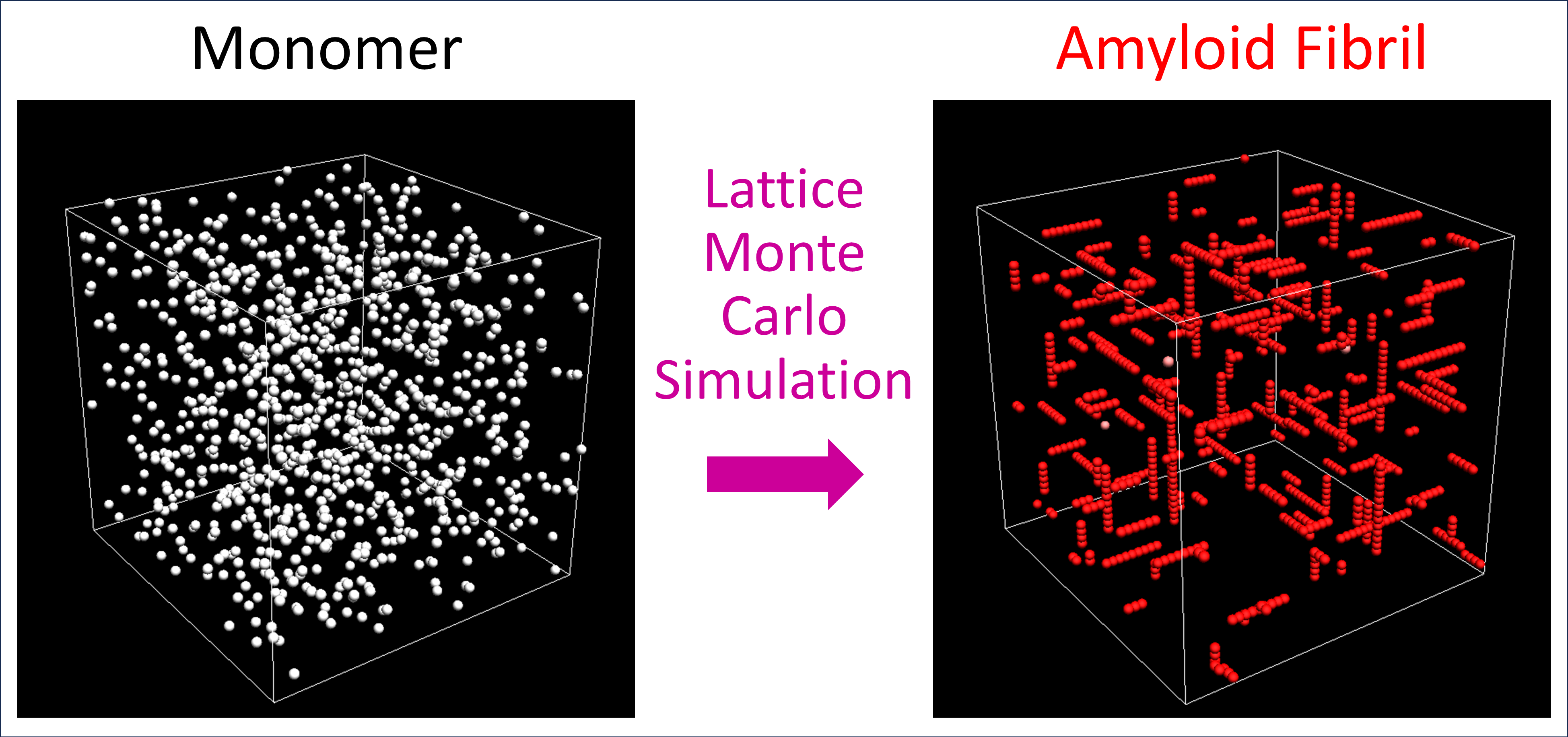
"A lattice Monte Carlo model for amyloid fibril formation"
URL:https://doi.org/10.2142/biophysico.bppb-v23.0015
- Abstract
- Proteins can aggregate to form amyloid fibrils, which are associated with a group of diseases collectively known as amyloidoses. Molecular dynamics simulations are widely used to study protein aggregation; however, it remains computationally challenging to investigate the entire aggregation process, from initial nucleation to the formation of mature amyloid fibrils, within a single simulation. In this study, we propose a Monte Carlo simulation based on a mathematical lattice model in which proteins are represented as spheres on a lattice. Motivated by the role of intramolecular β-sheet structures in accelerating aggregation, we classify protein states into three categories: monomer, intermediate possessing an intramolecular β-sheet structure, and fibril. By tuning the monomer-to-intermediate transition probability PMI and the intermediate-to-fibril transition probability PIF, both kinetics and morphology of amyloid fibril formation can be systematically controlled. When PMI is low, a lag time appears in the early stage of aggregation, whereas increasing PMI shortens the lag time. High values of both PMI and PIF lead to rapid aggregation and the formation of many short fibrils, while low values result in slower aggregation and fewer but longer fibrils. These results are consistent with experimental observations and indicate that amyloid fibril formation can be understood as a crystal growth process. This approach is expected to provide further insight into the universal mechanisms of amyloid fibril formation in homogeneous aqueous environments, as well as in heterogeneous and nonequilibrium systems.
URL: https://doi.org/10.2142/biophysico.bppb-v23.0015