
男女共同参画学協会連絡会
支援企業による広告記事
- ソーラボジャパン株式会社
- CAD を使って光学装置を設計してみよう
- 「生物物理」2025年10月号
- ソーラボジャパン株式会社
- 次世代2光子顕微鏡―小型化がもたらす新たな可能性
- 「生物物理」2024年10月号
- ソーラボジャパン株式会社
- サイエンティフィックカメラと周辺機器の同期
- 「生物物理」2023年10月号
- ソーラボジャパン株式会社
- 顕微鏡のリノベーション ~ 顕微鏡ポートを活用した光学系の導入
- 「生物物理」2022年12月号
「Biophysics and Physicobiology」に Yoshifumi Nishimura による "Dynamic networks of intrinsically disordered regions in nuclear proteins" をJ-STAGEの早期公開版として掲載
2026年06月06日 学会誌
日本生物物理学会欧文誌[Biophysics and Physicobiology]に以下の論文が早期公開されました。
Yoshifumi Nishimura
"Dynamic networks of intrinsically disordered regions in nuclear proteins"
URL:https://doi.org/10.2142/biophysico.bppb-v23.0020
- Abstract
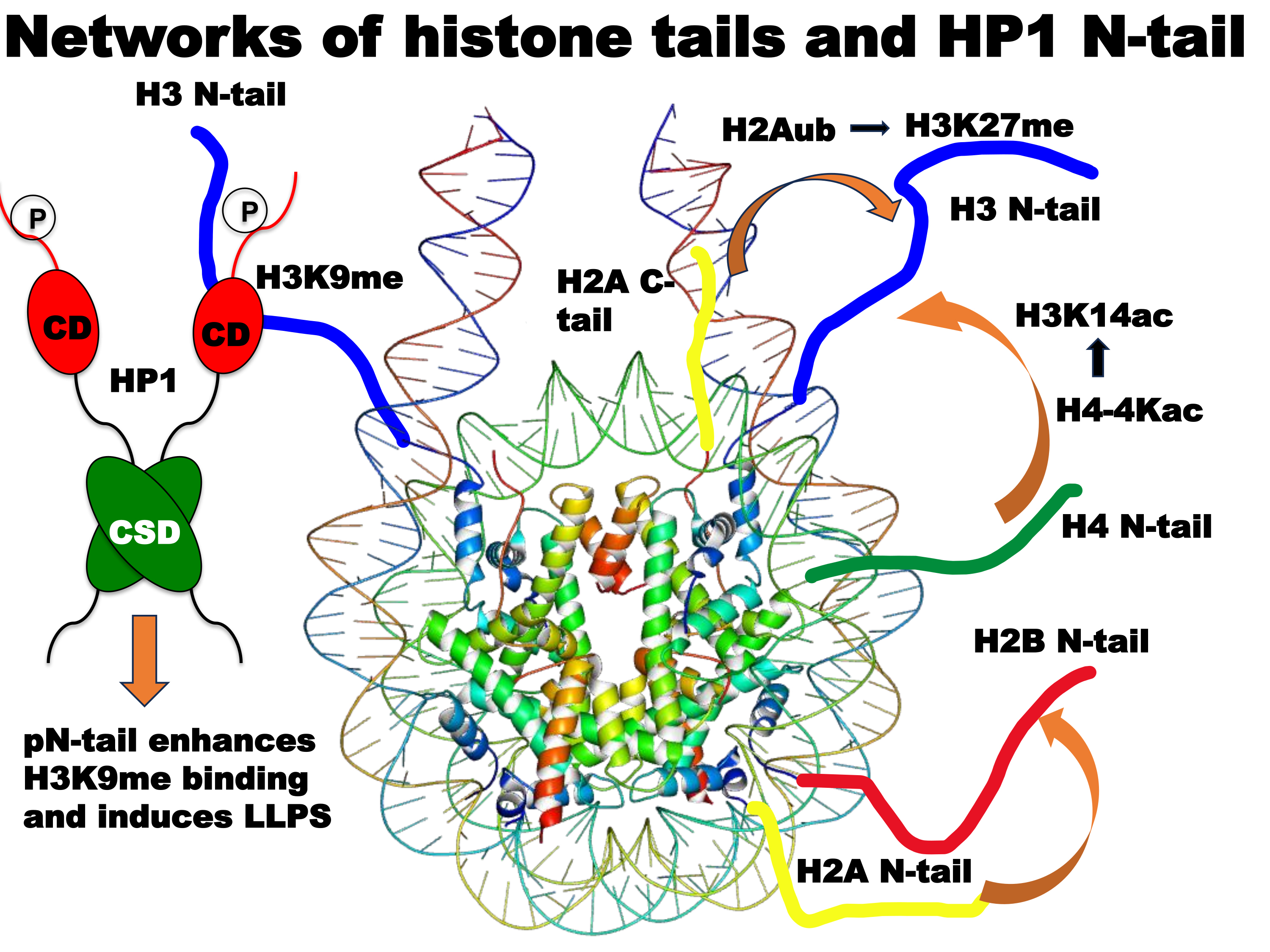
- Chromatin in the eukaryotic nucleus is organized into transcriptionally active euchromatin and transcriptionally silent heterochromatin. Its fundamental unit, the nucleosome, consists of two copies each of histones H2A, H2B, H3, and H4 wrapped by ~145 base pairs of DNA, flanked by linker-DNA that binds linker-histone H1 to form a chromatosome. In euchromatin, histone N-terminal tails (N-tails) are extensively acetylated. In facultative heterochromatin, H3K27 is methylated (H3K27me) and the H2A C-terminal tail (C-tail) is ubiquitinated (H2Aub), whereas in constitutive heterochromatin, H3K9 is methylated (H3K9me) and recognized by heterochromatin protein 1 (HP1). The N-tail of the HP1α homologue is phosphorylated, enhancing its binding to H3K9me and promoting liquid–liquid phase separation (LLPS). In addition, the C-tails of the histone chaperones FACT and NAP1 mediate binding to H2A–H2B. These N-tails and C-tails are intrinsically disordered regions (IDRs), whose dynamic conformations are accessible primarily through NMR spectroscopy. NMR has revealed dynamic IDR interaction networks essential for chromatin regulation, including H3 N-tail acetylation enhanced by H4 N-tail acetylation on linker-DNA, its suppression by H1, H3K27 methylation promoted by H2Aub, H3 N-tail acetylation induced by phosphorylated FACT C-tail, the role of the NAP1 C-tail in H2A–H2B binding, and phosphorylation-dependent enhancement of HP1 N-tail binding to H3K9me and LLPS. Thus, NMR has illuminated how dynamic interactions among nuclear IDRs play central roles in establishing euchromatin and heterochromatin, providing insights into the molecular basis of nuclear function.
URL: https://doi.org/10.2142/biophysico.bppb-v23.0020