
男女共同参画学協会連絡会
支援企業による広告記事
- ソーラボジャパン株式会社
- CAD を使って光学装置を設計してみよう
- 「生物物理」2025年10月号
- ソーラボジャパン株式会社
- 次世代2光子顕微鏡―小型化がもたらす新たな可能性
- 「生物物理」2024年10月号
- ソーラボジャパン株式会社
- サイエンティフィックカメラと周辺機器の同期
- 「生物物理」2023年10月号
- ソーラボジャパン株式会社
- 顕微鏡のリノベーション ~ 顕微鏡ポートを活用した光学系の導入
- 「生物物理」2022年12月号
「Biophysics and Physicobiology」に Junichi Higo, Yutaro Shiraishi, Gert-Jan Bekker, Narutoshi Kamiya, Takuya Takahashi, Yoshifumi Fukunishi, Koh Takeuchi, Ichio Shimada による "Ligand dissociation induces allosteric dynamic changes in the aptamer domain of the TPP riboswitch" をJ-STAGEの早期公開版として掲載
2026年10月10日 学会誌
日本生物物理学会欧文誌[Biophysics and Physicobiology]に以下の論文が早期公開されました。
Junichi Higo, Yutaro Shiraishi, Gert-Jan Bekker, Narutoshi Kamiya, Takuya Takahashi, Yoshifumi Fukunishi, Koh Takeuchi, Ichio Shimada
"Ligand dissociation induces allosteric dynamic changes in the aptamer domain of the TPP riboswitch"
URL:https://doi.org/10.2142/biophysico.bppb-v23.0033
- Abstract
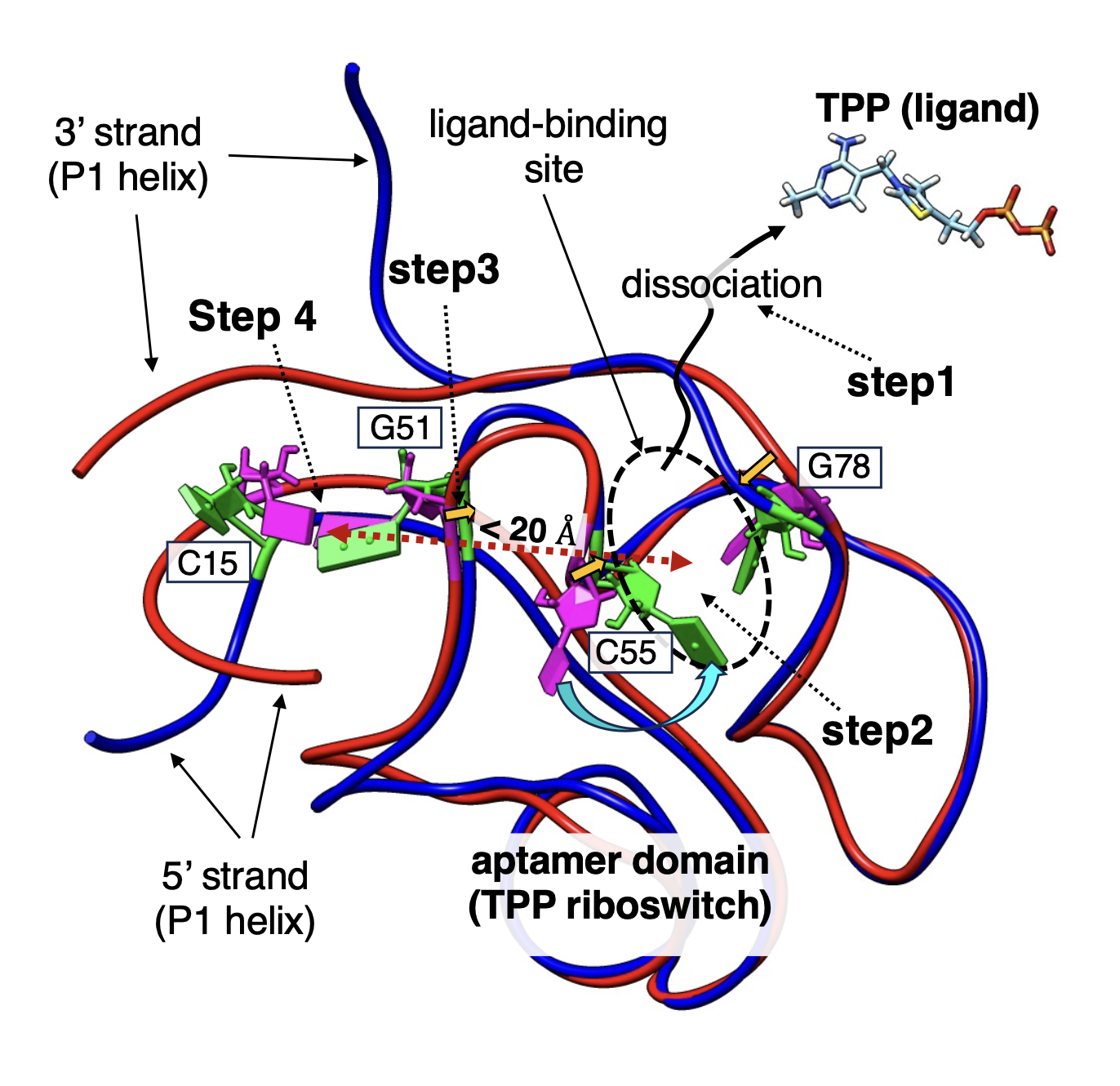
- The thiamine pyrophosphate (TPP) riboswitch, located in the mRNA 5'-UTR, consists of an aptamer domain and an expression platform. TPP dissociation from the ligand-binding site in the aptamer domain triggers an allosteric transition that increases the structural flexibility of the P1 helix and activates the expression platform for thiamine biosynthesis. However, the structural mechanism underlying this allosteric transition remains poorly understood. In this study, we investigated this mechanism using molecular simulations and NMR experiments. We employed a generalized-ensemble molecular dynamics simulation to perform extensive conformational sampling and to compute free-energy landscapes of the aptamer domain in the complex and ligand-free states at 300 K. Comparison of the two states revealed that ligand dissociation induces a contraction of the ligand-binding pocket. This structural change increases the distance between the C15 and G51 bases located at the root of the P1 helix, thereby destabilizing base-pair formation and triggering an increase in the conformational flexibility of the P1 helix. Notably, the C15–G51 base pair is located more than 20 Å from the ligand-binding site. Furthermore, the imino-proton exchange rate measured by NMR confirmed the destabilization of the C15–G51 base pair by ligand dissociation. These findings provide a mechanistic explanation for the allosteric transition triggered by ligand dissociation and offer insight into how this process regulates thiamine biosynthesis.
URL: https://doi.org/10.2142/biophysico.bppb-v23.0033