男女共同参画学協会連絡会
支援企業による広告記事
- ソーラボジャパン株式会社
- CAD を使って光学装置を設計してみよう
- 「生物物理」2025年10月号
- ソーラボジャパン株式会社
- 次世代2光子顕微鏡―小型化がもたらす新たな可能性
- 「生物物理」2024年10月号
- ソーラボジャパン株式会社
- サイエンティフィックカメラと周辺機器の同期
- 「生物物理」2023年10月号
- ソーラボジャパン株式会社
- 顕微鏡のリノベーション ~ 顕微鏡ポートを活用した光学系の導入
- 「生物物理」2022年12月号
「Biophysics and Physicobiology」に Yusuke V. Morimoto による "Developing interactive tools for understanding bacterial flagellar assembly and motility with generative AI assistance" をJ-STAGEの早期公開版として掲載
2026年11月18日 学会誌
日本生物物理学会欧文誌[Biophysics and Physicobiology]に以下の論文が早期公開されました。
Yusuke V. Morimoto
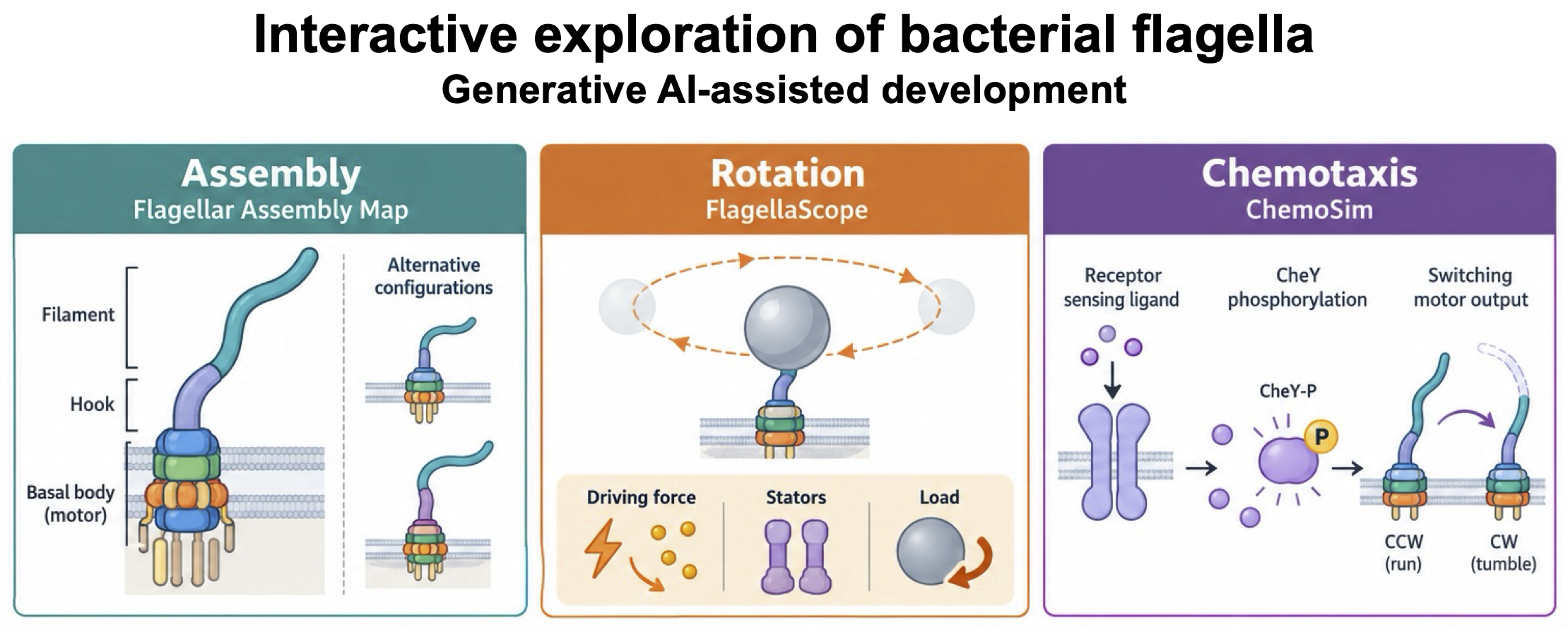
"Developing interactive tools for understanding bacterial flagellar assembly and motility with generative AI assistance"
URL:https://doi.org/10.2142/biophysico.bppb-v23.0036
- Abstract
- Bacterial flagellar motility connects molecular assembly, ion-driven torque generation, and chemotactic signaling control of rotation. Understanding these relationships requires readers to connect structural representations, dynamical models, and experimental measurements. I used generative AI to assist the development of three complementary browser-based interactive tools. Flagellar Assembly Map organizes selected assembly relationships across four bacterial species using structural diagrams, reference comparisons, and uncertainty-aware phenotype matching for deletion mutants. FlagellaScope illustrates how changes in motive force, stator occupancy, and viscous load can produce similar motor rotation speeds, while distinguishing model motion from camera-derived estimates. ChemoSim connects a conserved chemotaxis signaling pathway model to stochastic motor switching and provides condition-specific reference responses and optional motor calibration. The tools execute explicit rules and numerical models locally, with AI serving as a development aid. They provide complementary representations rather than a computationally coupled multiscale model. Numerical checks establish internal consistency within the tested scope. Representative examples illustrate ambiguity in interpreting motor rotation speeds, recovery of chemotactic signaling responses within a finite observation window, and differences among flagellar gene deletion mutants. By combining explanatory text with manipulable models, this approach offers a framework for exploring the assumptions that connect biological mechanisms to observations in bacterial flagellar research. Future integration into biophysics courses and laboratory training could support research discussions connecting molecular mechanisms with cellular behavior and promote active learning through users’ direct interaction with the tools.
URL: https://doi.org/10.2142/biophysico.bppb-v23.0036