

男女共同参画学協会連絡会
支援企業による広告記事
- ソーラボジャパン株式会社
- CAD を使って光学装置を設計してみよう
- 「生物物理」2025年10月号
- ソーラボジャパン株式会社
- 次世代2光子顕微鏡―小型化がもたらす新たな可能性
- 「生物物理」2024年10月号
- ソーラボジャパン株式会社
- サイエンティフィックカメラと周辺機器の同期
- 「生物物理」2023年10月号
- ソーラボジャパン株式会社
- 顕微鏡のリノベーション ~ 顕微鏡ポートを活用した光学系の導入
- 「生物物理」2022年12月号
「Biophysics and Physicobiology」に Mingwei Li, Ting Cheng, Chengtao Ding, Jiachen Yang, Wenming Yang, Yujun Liu, Shuwen Xu による "Structural dynamics of G626A Wilson disease ATP7B protein in complex with chaperone Atox1 revealed by molecular dynamics simulations" をJ-STAGEの早期公開版として掲載
2026年11月20日 学会誌
日本生物物理学会欧文誌[Biophysics and Physicobiology]に以下の論文が早期公開されました。
Mingwei Li, Ting Cheng, Chengtao Ding, Jiachen Yang, Wenming Yang, Yujun Liu, Shuwen Xu
"Structural dynamics of G626A Wilson disease ATP7B protein in complex with chaperone Atox1 revealed by molecular dynamics simulations"
URL:https://doi.org/10.2142/biophysico.bppb-v23.0038
- Abstract
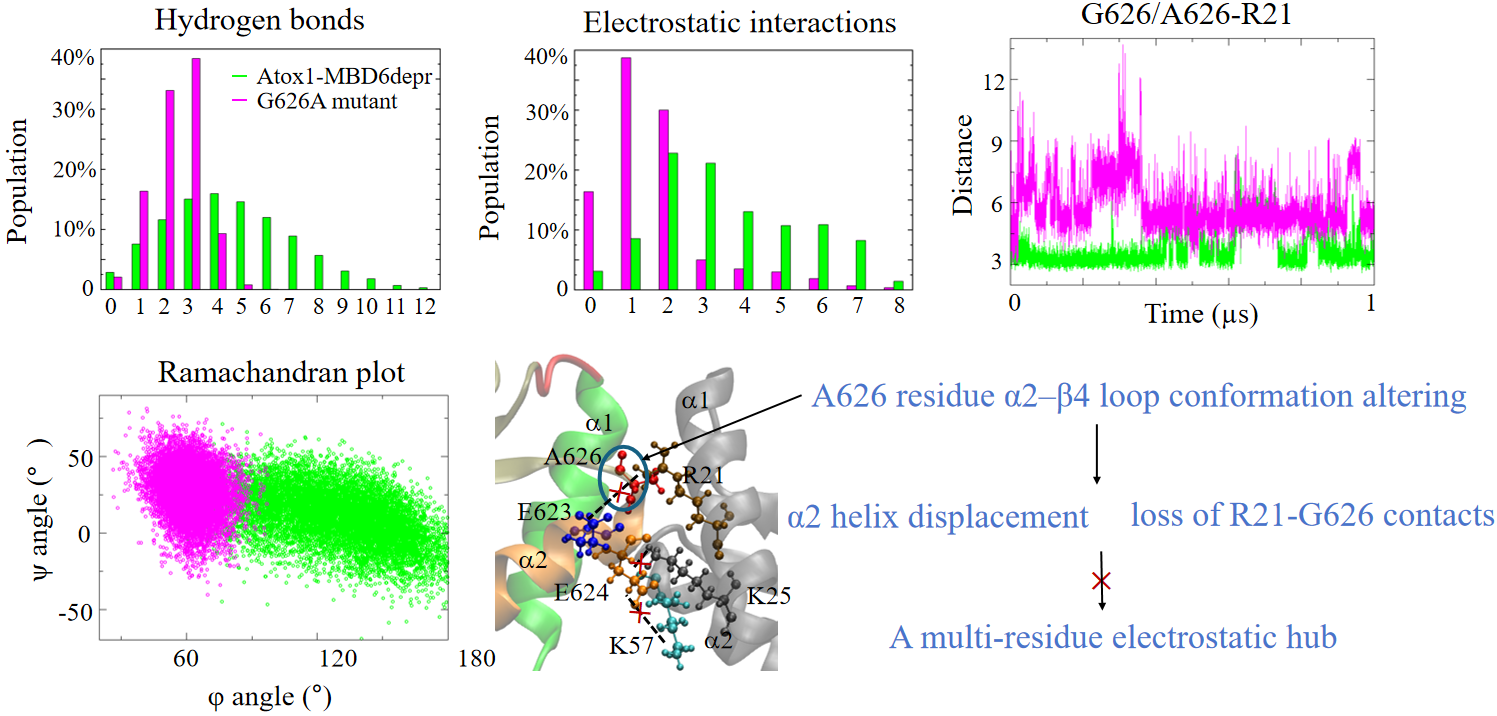
- The human transporter ATP7B maintains hepatic copper homeostasis by specific binding of its sixth metal-binding domain (MBD6) to the copper chaperone Atox1. The G626A mutation in MBD6 causes Wilson disease (WD), a disorder with hepatic and neurological manifestations. However, the molecular mechanism underlying the WD-associated G626A mutation remains poorly understood. To address this, we conducted molecular dynamics simulations and free energy calculations to explore the structural dynamics of the Atox1-MBD6 complex. Our findings show that deprotonation of C575 and C578 in MBD6 upon Cu(I) binding enhances the conformational stability of Atox1–Cu(I)–MBD6 complex. Importantly, the G626A mutation disrupts the critical hydrogen bond between G626 and R21 and weakens the electrostatic interaction network linking MBD6 residues E623/E624 to Atox1 residues R21/K25/K57, which ultimately reduces the interaction stability and structural integrity of the Atox1–Cu(I)–MBD6 complex. Our study offers valuable insights into the structural dynamics and stability of the Atox1-MBD6 complex, linking the WD mutation to protein dysfunction.
URL: https://doi.org/10.2142/biophysico.bppb-v23.0038