

男女共同参画学協会連絡会
支援企業による広告記事
- ソーラボジャパン株式会社
- ソーラボ製品をRaspberry Piで制御してみよう
- 「生物物理」2026年12月号
- ソーラボジャパン株式会社
- CAD を使って光学装置を設計してみよう
- 「生物物理」2025年10月号
- ソーラボジャパン株式会社
- 次世代2光子顕微鏡―小型化がもたらす新たな可能性
- 「生物物理」2024年10月号
- ソーラボジャパン株式会社
- サイエンティフィックカメラと周辺機器の同期
- 「生物物理」2023年10月号
「Biophysics and Physicobiology」に Shino Inukai, Takashi Nagata, Keiichi Inoue, Mitsumasa Koyanagi, Akihisa Terakita, Kota Katayama, Hideki Kandori による "Distinct chromophore and protein structural changes during Lumi formation in jellyfish rhodopsin" をJ-STAGEの早期公開版として掲載
2026年11月26日 学会誌
日本生物物理学会欧文誌[Biophysics and Physicobiology]に以下の論文が早期公開されました。
Shino Inukai, Takashi Nagata, Keiichi Inoue, Mitsumasa Koyanagi, Akihisa Terakita, Kota Katayama, Hideki Kandori
"Distinct chromophore and protein structural changes during Lumi formation in jellyfish rhodopsin"
URL:https://doi.org/10.2142/biophysico.bppb-v23.0041
- Abstract
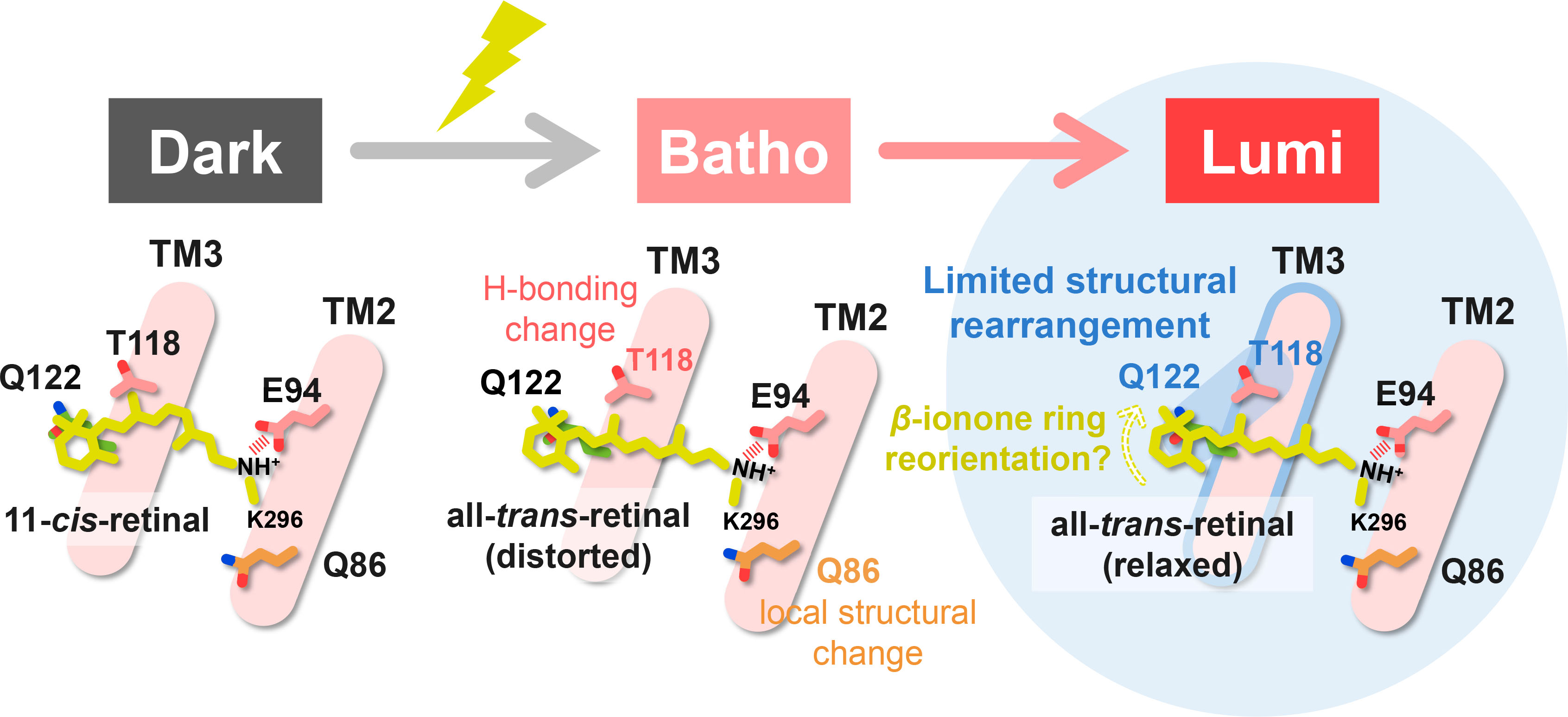
- Animal rhodopsins convert retinal photoisomerization into G-protein activation through structural changes in the chromophore and surrounding protein. Box jellyfish rhodopsin (JelRh) has a Schiff base counterion, Glu94, on transmembrane helix 2 (TM2), rather than on TM3 in vertebrate rhodopsins or in the second extracellular loop in many invertebrate rhodopsins. Here, we characterized the Lumi intermediate of JelRh using low-temperature UV–visible and Fourier-transform infrared (FTIR) spectroscopy and compared it with bovine rhodopsin (BovRh) and jumping spider rhodopsin-1 (SpiRh1). JelRh Lumi was red-shifted relative to the dark state but blue-shifted relative to Batho, as previously reported for squid and octopus rhodopsins. FTIR spectroscopy revealed relaxation of chromophore distortion during Lumi formation, a feature shared among these animal rhodopsins. Unlike BovRh, JelRh showed little detectable change in Schiff-base hydrogen-bonding strength from Batho to Lumi, consistent with previous findings for octopus rhodopsin. JelRh also exhibited characteristic protein structural changes, including carbonyl vibrational changes and the disappearance of the Thr118 O–H stretching change upon Lumi formation. Mutations of Thr118 and Gln122 on TM3 increased the amide-I changes, while Q122A also enhanced light-dependent cAMP response without increasing overall receptor expression. Although these observations do not directly link Lumi structural changes to receptor signaling, they indicate that TM3 residues influence the early structural response of JelRh. Together, these findings reveal how shared chromophore relaxation can be accompanied by different protein structural changes among animal rhodopsins.
URL: https://doi.org/10.2142/biophysico.bppb-v23.0041